

Refunds and recovery
Funds only leave a transfer’s contract in three ways: settlement to you, a refund to the customer, or a recovery of tokens that don’t belong to the payment. All three are sent by the operator wallet.
Automatic refunds
Section titled “Automatic refunds”Kite refunds without you doing anything when:
- the customer paid less than the amount, and the transfer expired;
- the customer paid after the transfer was cancelled;
- settlement failed, for example because a swap couldn’t meet the quoted minimum.
The refund goes to the refund address the customer gave at checkout.
Refunding by hand
Section titled “Refunding by hand”Open a transfer in the dashboard and choose Refund, or call POST /api/transfers/{id}/refund. The button only appears when there’s something to refund, and the API refuses, with 409, when:
- the transfer has settled or was already refunded;
- the pay-in address is empty, as with a transfer that expired unpaid;
- the payment came through x402 and its funds are held for manual resolution.
Before a transfer expires, only the operator can refund it. After it expires, anyone can call the contract’s refund, so a customer is never stuck waiting on the server.
Recovery
Section titled “Recovery”Recovery sends a token that isn’t part of the payment from the pay-in address to an address you choose: tokens sent by mistake, or a refund or overpayment the customer’s address couldn’t accept.
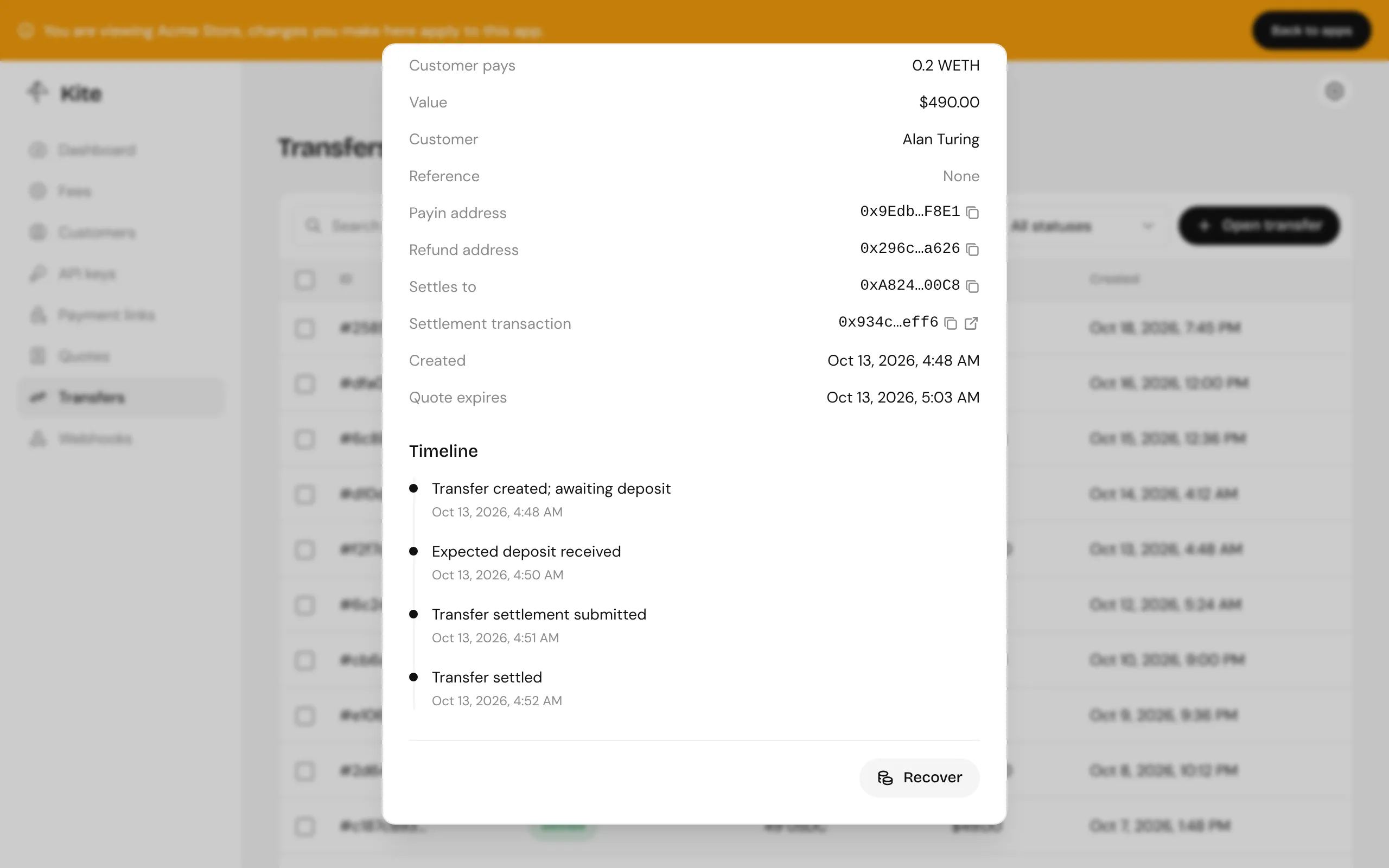
In the dashboard, choose Recover, check the address’s balance of the token, and send it. Through the API, POST /api/transfers/{id}/recover. Kite refuses, with 409, before any transaction is sent, when:
- there’s none of that token at the address;
- the transfer is still open and the token is its own pay-in or settlement token. Those only leave by settling or refunding.
Kite also recovers stray tokens on its own, back to the refund address, when a deposit notifier reports them.